


Some knee injuries tear more than one of the knee’s major ligaments at once — the ACL, PCL, the inner (MCL) or outer (LCL) ligaments, and the posterolateral corner. The most severe is a knee dislocation. These are among the most complex problems in orthopaedics, and relatively few surgeons in Adelaide are trained to perform the reconstruction. Knowing your surgeon works at this end of knee surgery — and teaches it — is reassurance that your own, more routine injury is in expert hands.
The serious end of knee injury
Some knee injuries tear more than one of the knee’s major ligaments at once — the ACL, PCL, the inner (MCL) or outer (LCL) ligaments, and the posterolateral corner at the outside-back of the knee. The most severe is a knee dislocation.
These injuries follow high-energy events — a heavy fall, a motor-vehicle or motorbike accident, a serious sporting collision — and they are among the most complex problems in orthopaedics.
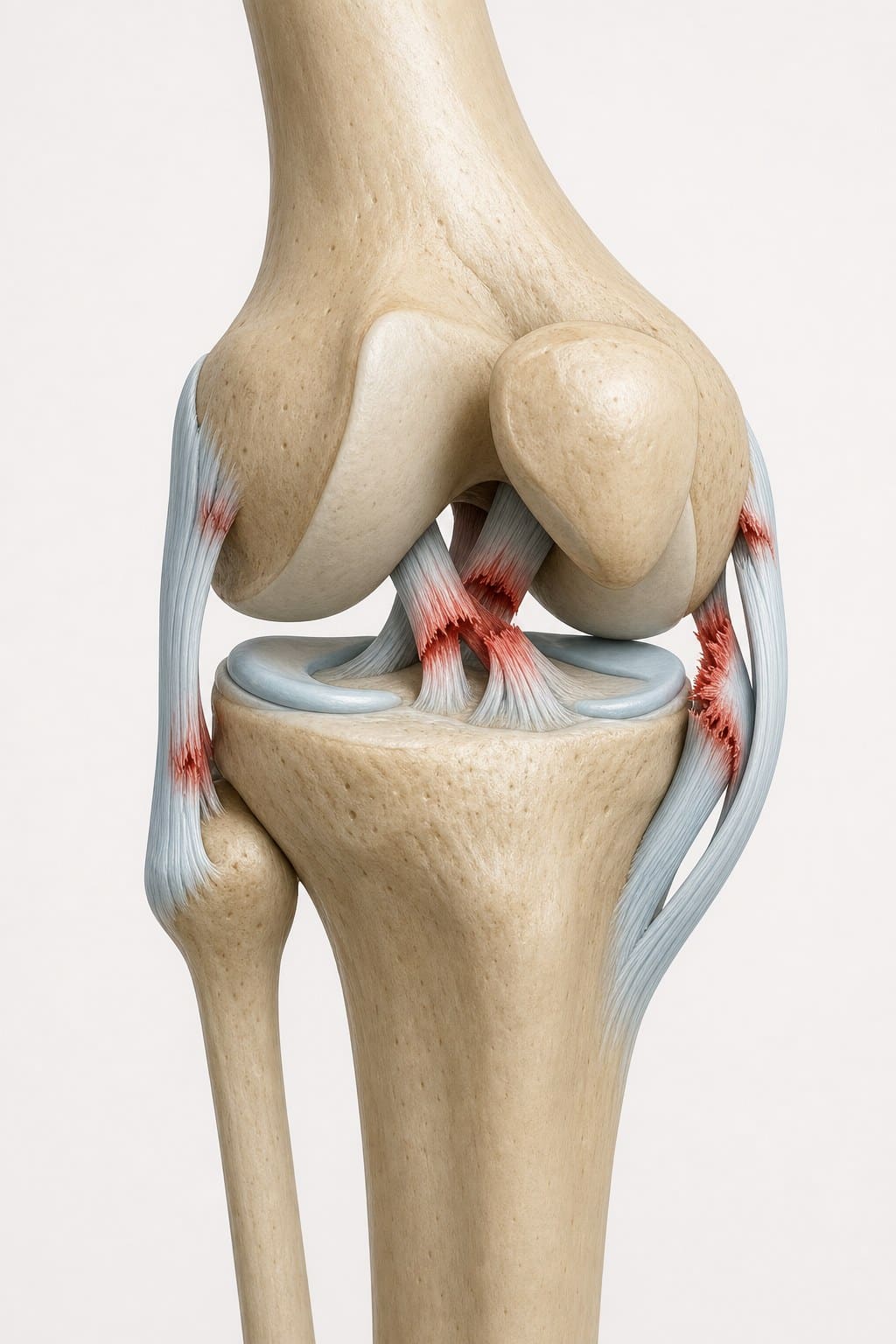
Several of the knee’s major ligaments torn at once (frayed areas shown in red). Stylised illustration.
Why these operations require a different level of surgical skill
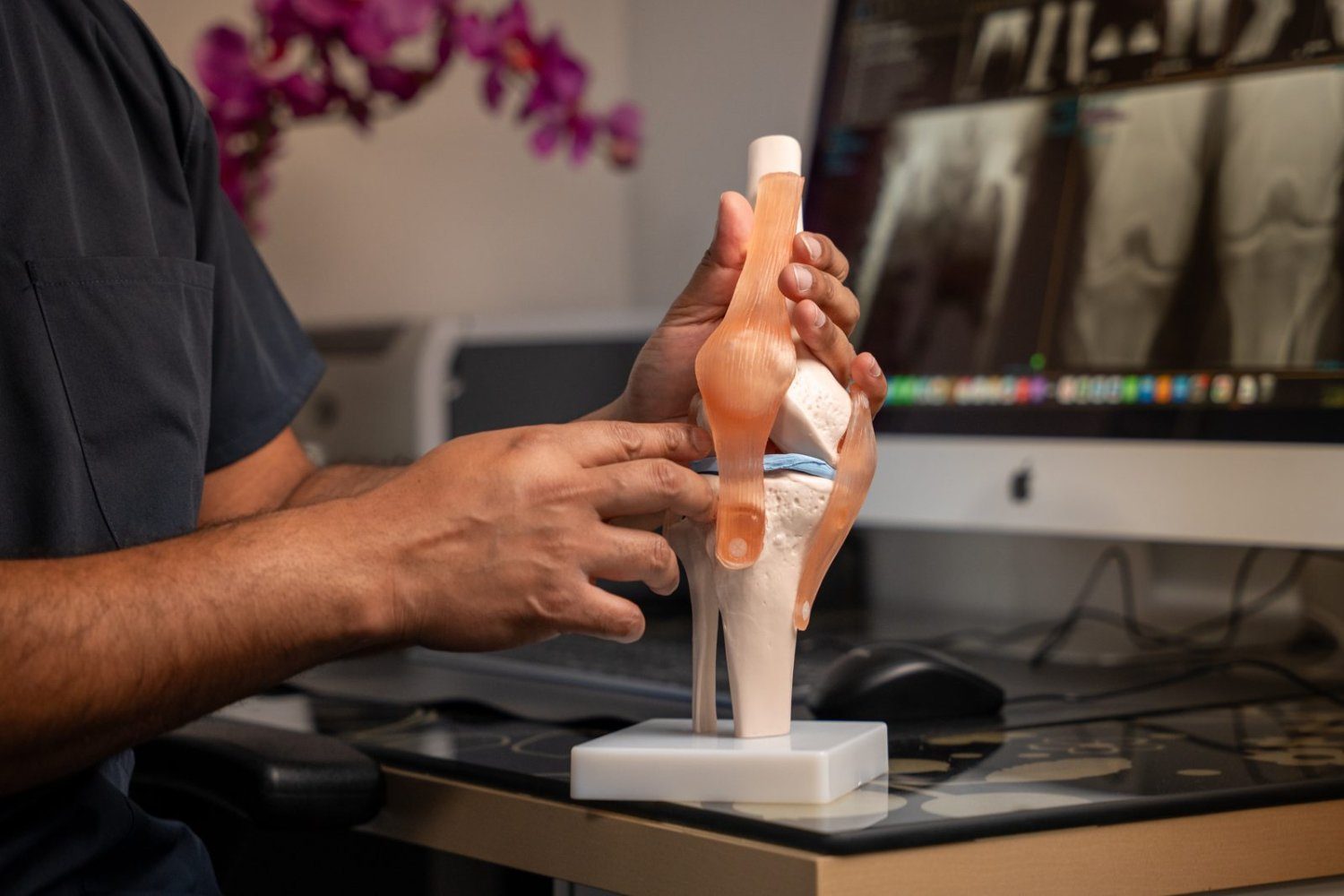
Rebuilding several ligaments in the same knee — for example the ACL together with the PCL and the corner ligaments — is a fundamentally different undertaking from routine keyhole knee surgery.
Most knee arthroscopy is done through two small keyhole openings (portals) and takes well under an hour. A multi-ligament reconstruction can run for four to five hours and demands a level of arthroscopic skill well beyond standard technique: many more precisely placed working portals; angled cameras and specialised instruments to reach the back and corners of the knee; sustained dexterity at difficult angles for hours; and multiple graft options anchored and tensioned anatomically in one carefully sequenced operation.
These injuries also sit beside the main artery and nerves behind the knee, so prompt, accurate assessment matters, and every torn structure is reconstructed so none is left to overload the others.
Why this matters to you
You cannot watch a surgeon operate and judge their skill — but "surgeons travel from interstate and overseas to learn these operations from him" is something anyone can understand.
You may never need surgery at this level — and that is exactly the point. Most knee injuries are far simpler. Knowing your surgeon works at the most complex end of knee surgery, and teaches it to others, is the reassurance that your own, more routine injury is in expert hands.
Key takeaways
Request a consultation
Send a few details and the rooms will be in touch within one business day.
Ask Dr Yas a question
Have a question about your knee? Send it through and Dr Yas’s rooms will respond. General information, not individual diagnosis.
Ask a questionMore on knee injuries
Latest insights from Dr Yas
Plain-language articles on modern hip & knee surgery — written to help you make an informed decision.

- Levy BA, et al. Decision making in the multiligament-injured knee. Arthroscopy. 2009;25(4):430–438.
- LaPrade RF, et al. Posterolateral corner injuries of the knee. Journal of the American Academy of Orthopaedic Surgeons. 2017;25(5):e92–e102.