
Been told you’re “too heavy” for a hip or knee replacement?
Do you have a worn-out, painful hip or knee and a BMI over 40? Have you been told to lose weight first, but the pain won’t let you? You still have options. Dr Yas looks at you as a person, not a number.

Dr Yas Edirisinghe is a specialist orthopaedic surgeon in Adelaide. He assesses hip and knee replacement for people with a higher body weight, including a BMI over 40, one person at a time, not by a BMI cut-off. He sees patients at Anzac Medical Suites in Ashford and operates at Ashford, Burnside and Calvary Central Districts hospitals.
Many hospitals will not do a hip or knee replacement if your BMI is over 40. The reason is real. Problems after surgery are more common at a higher weight. But Australia’s own joint registry has found that your general health predicts those problems better than your weight does. Dr Yas looks at the whole picture. He is honest about the extra risks. If surgery is right for you, he plans it to be as safe as it can be.
Reviewed by Dr Yas Edirisinghe · September 2026
Told to lose weight first, but the pain stops you exercising?
You have probably heard it more than once: “Come back when you’ve lost twenty kilos.” So you try. But a worn hip or knee will not let you walk far, let alone work out. The weight stays. The joint gets worse. The door stays shut.
You do not have to accept this as your “new normal”. A worn joint and a higher body weight feed each other. Pain makes you move less. Moving less makes weight harder to lose. Extra weight wears the joint out faster. That is a medical cycle, not a personal failing. For some people, fixing the joint is what breaks the cycle.
A worn hip or knee and a higher body weight feed each other. Assessment and treatment can break the loop.
What is BMI, and why do hospitals use 40 as the cut-off?
BMI stands for body mass index. It is one number worked out from your weight and your height: your weight in kilograms, divided by your height in metres, then divided by your height again. A BMI of 25 to 30 is called overweight. Over 30 is called obese. Over 40 is sometimes called severe or class 3 obesity.
Doctors use BMI because it is quick. But it has real limits. It cannot tell fat from muscle. A strong, heavy person can score “high”. It does not show where the weight sits, and weight around the middle matters more for health than weight on the hips or legs. It is also less accurate for older people and for people from some backgrounds. The Australian Institute of Health and Welfare says BMI “does not directly measure body fat” and “is not a good overall indicator of health”.
So why do hospitals use it? Because on average, people with a BMI over 40 do have more problems after a hip or knee replacement. A large review of 20 studies found about twice the chance of a wound infection and about a 30 per cent higher chance of needing a re-do operation. Faced with that, many hospitals set a simple rule: no joint replacement over a BMI of 40. It is quick, it is easy to apply, and it turns away a lot of people who would have done well.
Read: Why individual assessments matter more than BMI cut-offs →
Is BMI the best measure of my risk?
No. Not on its own. When you have an operation, the anaesthetist gives you a fitness grade from 1 to 4. It is called your ASA class. Grade 1 means you are healthy. Grade 2 means you have a mild condition that is under control, such as treated blood pressure. Grade 3 means a serious condition that limits you, such as poorly controlled diabetes or heart disease. Grade 4 means a condition that is a constant threat to life.
In 2025, researchers looked at more than 274,000 knee replacements from Australia’s national joint replacement registry. They found that this fitness grade predicts early problems after a knee replacement better than BMI does. For people in grade 1 or 2, being heavier made no measurable difference to the chance of needing a re-do operation. In people in grade 3 or 4, a BMI over 35 did add to the risk of infection.
The UK’s registry, with almost half a million knee replacements, found the same pattern. Every weight group stayed inside the accepted benchmark for how long a knee replacement should last. And people who were overweight had a slightly lower risk of dying after surgery than people of normal weight, not a higher one.
This is the heart of Dr Yas’s approach. Your weight is one factor. Your general health is a bigger one. A number alone should not decide.
How does Dr Yas assess a patient with a higher BMI?
Dr Yas does not start from “no”. At your first visit he looks at four things.
Then he tells you plainly where you stand: ready now, ready after some preparation, or not safe to go ahead, and why. You leave knowing exactly what would change the answer.

Why is the operation harder at a higher body weight, and what does Dr Yas do differently?
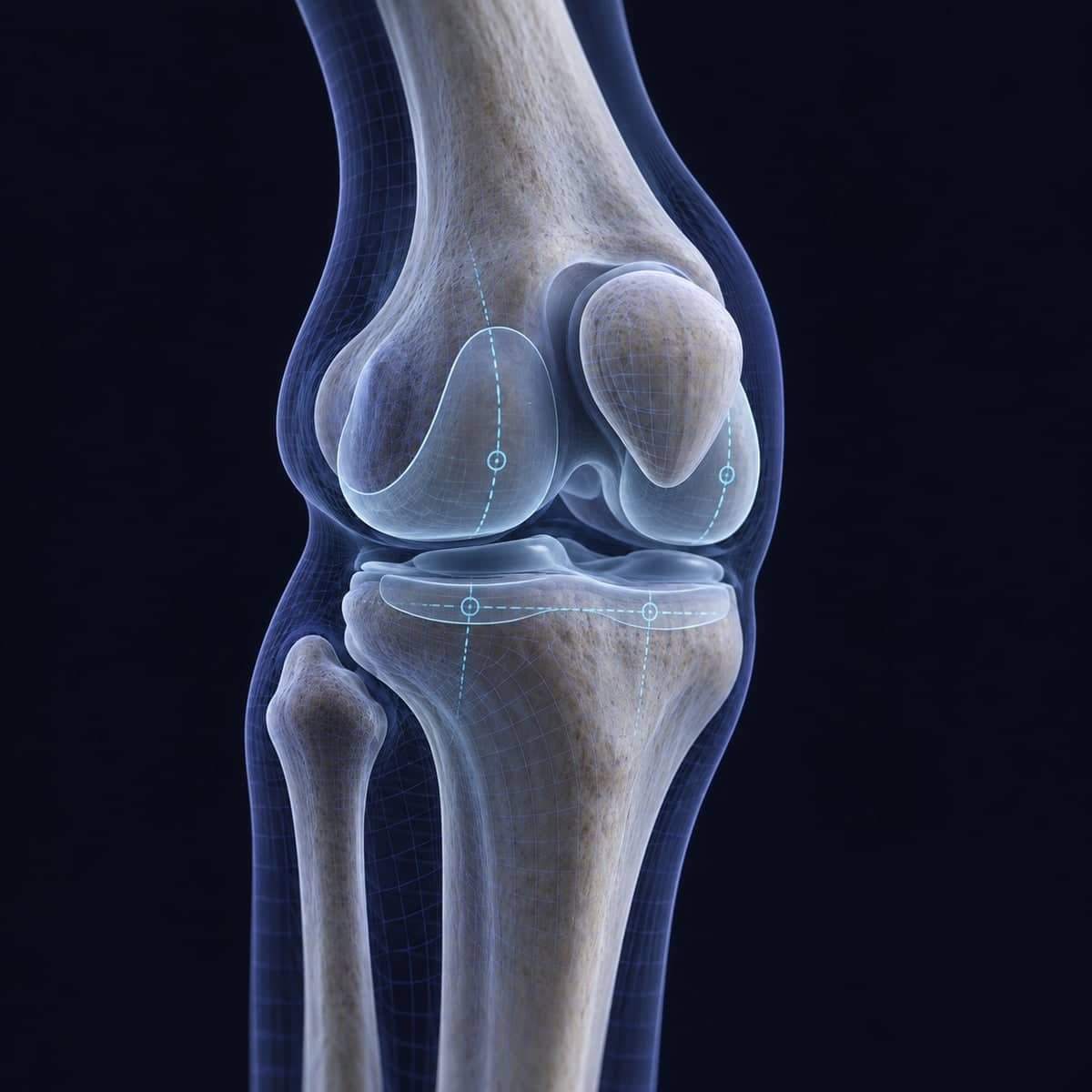
A hip or knee replacement is harder to do in a bigger joint. The surgeon has to work through a thicker layer of tissue to reach the joint. The bony landmarks are harder to see and feel. And in the knee, the ligaments that hold the joint steady are easier to damage on the way in.
Research shows where the problems come from. In one well-known study, the main ligament on the inside of the knee was torn during surgery in 8 out of 100 very heavy patients. It happened to none of the normal-weight patients. A damaged ligament means an unstable knee, and often a re-do operation. Other studies show that the thicker the tissue around the knee, the higher the chance of wound problems and infection.
In other words, the trouble is not the number on the scales. It is what happens inside the joint during the operation.
That is why Dr Yas does these operations differently. Before the day, he plans every hip and knee as a three-dimensional simulation in a highly specialised, state-of-the-art computer system, which maps the operation that is right for your joint. In theatre he uses a robotic arm to make the bone cuts exactly where they were planned. In studies of very heavy patients, robotic surgery cut the number of knees put in “off target” by about half. Robotic planning also means fewer ligaments need to be cut or released to balance the knee. There is less disturbance to the soft tissue around the joint. Dr Yas protects the ligaments. He keeps the cut and the dissection to what the operation needs. He closes the wound with the thicker tissue in mind. Planning the operation with the latest technology, and Dr Yas’s expert understanding of the anatomy of a higher-BMI hip or knee, is what makes the difference.
Experience matters too. At one large American hospital, hip replacements done by surgeons who do a lot of them were studied by weight group. Patients with a BMI over 40 had the same rates of readmission and re-do surgery as lighter patients. Among the less experienced surgeons at the same hospital, the heavier patients did worse. In the UK, complex re-do knee surgery has been moved into specialist centres, because surgeons who do more of these operations have fewer failures. Dr Yas regularly performs revision (re-do) and complex hip and knee surgery, including joint replacements that have been turned down elsewhere. He brings that same skill set to every hip or knee replacement at a higher body weight.
How is the rest of the risk lowered before surgery?
The risk that is left can be brought down further before the day of surgery. Dr Yas works with your GP, and sometimes a physician or an anaesthetist, to get you ready. Doctors call this optimisation. It means getting your body into the best shape it can be before an operation. For most people it covers four things.
- Diabetes control. Getting your blood sugar into a safe range before surgery, because high sugar makes infection more likely.
- Nutrition. Checking your protein, iron and vitamin D, and topping up anything that is low, so your wound heals well.
- Muscle strength. A simple strength programme before surgery. Many people with a painful hip or knee have lost muscle without noticing. Doctors call this sarcopenia. Building it back makes recovery faster.
- Skin preparation. The skin around the joint is checked before surgery and cleaned with antiseptic on the day, because the skin is where an infection would start.
After surgery, blood-clot prevention and getting you walking early are planned from day one. None of this makes the risk zero. It makes the risk known, talked through and reduced. The decision stays yours.

Should I lose weight before a hip or knee replacement, and is faster better?
Losing weight is good for an arthritic hip or knee. Every kilo you carry adds load to the joint. Australian GP guidelines suggest that people with hip or knee arthritis aim to lose 5 to 7.5 per cent of their body weight, with exercise. In one long-term study, every 1 per cent of body weight lost cut the chance of needing a knee replacement by about 2 per cent.
But faster is not better, and this is where the “come back lighter” advice goes wrong. Losing a lot of weight quickly in the months before surgery has not been shown to make the operation safer. Several large studies found the opposite. People who lost more than 10 per cent of their body weight in the six months before a joint replacement were almost twice as likely to be readmitted to hospital. They were also more likely to have low protein in their blood, a sign of poor nutrition. Crash dieting loses muscle as well as fat, and you need muscle and good nutrition to heal a wound and get walking again.
Weight-loss surgery before a hip or knee replacement is not a shortcut either. The newest reviews found no clear benefit for the joint, and some higher risks. And people who lost a modest 5 per cent before surgery, including in an Australian study, did about the same as people who did not.
So Dr Yas does not set a number you have to reach before he will see you. If you are heavier than you would like, it almost certainly did not happen overnight. For most people it built up over years, through pain, injury, work, family, medicines and life itself. It is fair to expect that bringing it down safely will take time as well. That is not a reason to give up. It is a reason to start with changes you can keep, rather than a crash diet before an operation. Steady weight loss, regular movement and keeping your muscle are the goal. Your GP or a dietitian can help you plan it.
The newer weight-loss injections, such as Ozempic, Wegovy and Mounjaro, which your GP may call GLP-1 medicines, have changed things for some patients. Early studies suggest people on them before a joint replacement are a little less likely to be readmitted to hospital. There is no sign of extra surgical harm, though the research is young. Your GP or a diabetes specialist prescribes and monitors them, not Dr Yas. If you are taking one, tell the team when you book your surgery. Current Australian advice for anaesthetists is that you do not need to stop the injection. But because these medicines slow down your stomach, you will be asked to have clear fluids only for the whole day before your operation, and then the usual fasting. Your anaesthetist will confirm the plan with you.

When can hip or knee replacement go ahead at a BMI over 40?
After your assessment, these things support going ahead:
Supports going ahead
- Severe wear in the joint on X-ray that matches your pain.
- Pain that limits everyday life even after the non-surgical options: physio, weight management, pain management, and injections where they are appropriate.
- Diabetes, blood pressure and sleep apnoea under control and checked by your GP or specialist.
- No health problem that makes surgery or an anaesthetic unsafe right now.
- A clear understanding of the higher risks, and a willingness to prepare.
Not yet, because
- diabetes that is not under control;
- sleep apnoea that has not been treated;
- an infection or an open sore near the joint;
- a heart or lung problem that needs treatment first.
For every 1 complication a strict BMI-40 rule prevents, about 14 people are turned away who would have had a trouble-free operation.
These things would make Dr Yas say “not yet”: diabetes that is not under control; sleep apnoea that has not been treated; an infection or an open sore near the joint; a heart or lung problem that needs treatment first. “Not yet” is the key phrase. The answer often changes once those things are sorted out.
It is worth knowing what is on the other side of the decision. People with a BMI over 40 gain about as much from a joint replacement as everyone else. In the UK knee registry, their knee scores improved by the same amount as lighter patients. And one large study worked out that a strict BMI-40 rule would turn away about 14 people who would have had a trouble-free operation for every one complication it prevented.
This is general information, not a decision. Your own plan is worked out at your consultation.
- A higher body weight is one factor among many, not an automatic no.
- Your general health predicts problems after surgery better than your BMI does.
- Dr Yas looks at the whole picture: your joint, how you move, your health and your goals.
- The way the operation is done matters. Dr Yas protects the soft tissues and plans every hip and knee with robotic accuracy.
- Slow, steady weight loss helps your joints. Crash dieting before surgery does not.
- He is honest about the extra risks and plans to reduce them. He never promises an outcome.
Common questions
Is there a weight limit for hip or knee replacement?
Can I have a hip or knee replacement with a BMI over 40 in Adelaide?
I was told to lose weight first, but the pain stops me exercising. What can I do?
Do I have to lose weight before a hip or knee replacement?
Will I get as much benefit as a lighter patient?
Does a higher BMI increase the risks of hip or knee replacement?
Will I definitely be able to have surgery?
Ask Dr Yas your questions and concerns
Dr Yas wants you to ask questions. Get in touch, and he will do his best to answer them and ease your concerns. Send your questions and a few details, and the rooms will be in touch within one business day. A GP referral helps but is not required.
- A proper assessment — your history, an examination and your scans, reviewed with you
- A clear plan — the options for your hip or knee, in plain language
- Every question answered — nothing is too small or too early to ask
Have a question about your hip or knee?
Ask about your options, the risks, or whether an assessment makes sense for you. It takes two minutes.
Do you have private health insurance?
Send your question
Write as much or as little as you like.
Thank you
The rooms can talk you through your options and what a consultation involves.
Contact Dr YasRelated reading
- Kerkhoffs GMMJ, Servien E, Dunn W, Dahm D, Bramer JAM, Haverkamp D. The influence of obesity on the complication rate and outcome of total knee arthroplasty: a meta-analysis and systematic literature review. J Bone Joint Surg Am. 2012;94(20):1839–1844.
- Wall CJ, de Steiger RN, Vertullo CJ, Harries D, Kondalsamy-Chennakesavan S. ASA class is a stronger predictor of early revision risk following primary total knee arthroplasty than BMI. JBJS Open Access. 2025;10(1):e24.00064.
- Wall CJ, Vertullo CJ, Kondalsamy-Chennakesavan S, Lorimer MF, de Steiger RN. A prospective, longitudinal study of the influence of obesity on total knee arthroplasty revision rate: results from the Australian Orthopaedic Association National Joint Replacement Registry. J Bone Joint Surg Am. 2022;104(15):1386–1392.
- Evans JT, Mouchti S, Blom AW, et al. Obesity and revision surgery, mortality, and patient-reported outcomes after primary knee replacement surgery in the National Joint Registry: a UK cohort study. PLoS Med. 2021;18(7):e1003704.
- Chaudhry H, Ponnusamy K, Somerville L, McCalden RW, Marsh J, Vasarhelyi EM. Revision rates and functional outcomes among severely, morbidly, and super-obese patients following primary total knee arthroplasty: a systematic review and meta-analysis. JBJS Rev. 2019;7(7):e9.
- Baker P, Petheram T, Jameson S, Reed M, Gregg P, Deehan D. The association between body mass index and the outcomes of total knee arthroplasty. J Bone Joint Surg Am. 2012;94(16):1501–1508.
- Giori NJ, Amanatullah DF, Gupta S, Bowe T, Harris AHS. Risk reduction compared with access to care: quantifying the trade-off of enforcing a body mass index eligibility criterion for joint replacement. J Bone Joint Surg Am. 2018;100(7):539–545.
- Winiarsky R, Barth P, Lotke P. Total knee arthroplasty in morbidly obese patients. J Bone Joint Surg Am. 1998;80(12):1770–1774.
- Yu S, Siow M, Odeh K, Long WJ, Schwarzkopf R, Iorio R. Periarticular soft tissue envelope size and postoperative wound complications following total knee arthroplasty. J Arthroplasty. 2018;33(7S):S249–S252.
- Heifner JJ, Sakalian PA, Rowland RJ, Corces A. Local adiposity may be a more reliable predictor for infection than body mass index following total knee arthroplasty: a systematic review. J Exp Orthop. 2023;10:113.
- Richardson MK, DiGiovanni RM, McCrae BK, et al. Robotic-assisted total knee arthroplasty in obese patients. Arthroplasty Today. 2024;26:101320.
- Zurrón Lobato M, et al. The use of navigation during total knee replacement improves precision in achieving mechanical alignment in obese patients: a randomised multicentre trial. JBJS Open Access. 2025;10(4):e25.00220.
- Spitzer AI, Gorab RS, Barrett WP, et al. Robotic-assisted total knee arthroplasty reduces soft-tissue releases which improves functional outcomes: a retrospective study. Knee. 2024;49:1–8.
- Kayani B, Konan S, Pietrzak JRT, Haddad FS. Iatrogenic bone and soft tissue trauma in robotic-arm assisted total knee arthroplasty compared with conventional jig-based total knee arthroplasty: a prospective cohort study and validation of a new classification system. J Arthroplasty. 2018;33(8):2496–2501.
- Shichman I, Oakley CT, Ashkenazi I, et al. Does experience with total knee arthroplasty in morbidly obese patients effect surgical outcomes. Arch Orthop Trauma Surg. 2024;144:385–392.
- Ashkenazi I, Thomas J, Lawrence KW, Meftah M, Rozell JC, Schwarzkopf R. The impact of obesity on total hip arthroplasty outcomes when performed by high-volume surgeons: a propensity matched analysis from a high-volume urban center. J Arthroplasty. 2024;39(6):1412–1418.
- British Orthopaedic Association and British Association for Surgery of the Knee. BOAST: Revision total knee replacement surgical practice guidelines. London: BOA; 2020.
- Matthews AH, Gray WK, Evans JP, et al. Higher surgeon volume reduces early failure in first time revision of non-infected total knee arthroplasty: an analysis using data from the United Kingdom National Joint Registry. Knee Surg Sports Traumatol Arthrosc. 2025. doi:10.1002/ksa.12690.
- Getting It Right First Time (NHS England). National revision knee surgery programme: end of pilot phase report. February 2026.
- Royal Australian College of General Practitioners. Guideline for the management of knee and hip osteoarthritis. 2nd ed. East Melbourne: RACGP; 2018.
- Salis Z, Sainsbury A, Keen HI, Gallego B, Jin X. Weight loss is associated with reduced risk of knee and hip replacement: a survival analysis using Osteoarthritis Initiative data. Int J Obes. 2022;46:874–884.
- Schmerler J, Hussain N, Kurian SJ, Khanuja HS, Oni JK, Hegde V. Preoperative weight loss before total hip arthroplasty negatively impacts postoperative outcomes. Arthroplasty. 2024;6:13.
- Inacio MCS, Kritz-Silverstein D, Raman R, et al. The risk of surgical site infection and re-admission in obese patients undergoing total joint replacement who lose weight before surgery and keep it off post-operatively. Bone Joint J. 2014;96-B(5):629–635.
- Kim BI, Cochrane NH, O’Donnell JA, et al. Preoperative weight loss and postoperative weight gain independently increase risk for revision after primary total knee arthroplasty. J Arthroplasty. 2022;37(4):674–682.
- Pavlovic N, Harris IA, Boland R, Brady B, Genel F, Naylor J. The effect of body mass index and preoperative weight loss in people with obesity on postoperative outcomes to 6 months following total hip or knee arthroplasty: a retrospective study. Arthroplasty. 2023;5:48.
- Godziuk K, Prado CM, Woodhouse LJ, Forhan M. The impact of sarcopenic obesity on knee and hip osteoarthritis: a scoping review. BMC Musculoskelet Disord. 2018;19:271.
- Faraz M, Bhat S, Gufran S, Calvert N. Bariatric surgery prior to hip and knee arthroplasty: a systematic review and meta-analysis of postoperative outcomes. ANZ J Surg. 2026;96(5):1109–1123.
- Liu P, Meng J, Tang H, et al. Association between bariatric surgery and outcomes of total joint arthroplasty: a meta-analysis. Int J Surg. 2025;111(1):1541–1546.
- Chan YC, Chuang SH, Wu LC, Kuo YJ, Lian YZ, Chen YP. Glucagon-like peptide-1 receptor agonists, readmission, and postoperative complications in arthroplasty: a systematic review and meta-analysis. J Arthroplasty. 2026;41(8):2530–2538.
- Australian Diabetes Society, Australian and New Zealand College of Anaesthetists, Gastroenterological Society of Australia, National Allied Health Casemix Committee. Clinical practice recommendations regarding patients taking GLP-1 receptor agonists and dual GIP/GLP-1 receptor agonists: peri-procedural management. April 2025.
- National Institute for Health and Care Excellence. Osteoarthritis in over 16s: diagnosis and management (NG226). London: NICE; 2022.
- Australian Institute of Health and Welfare. Overweight and obesity: measuring overweight and obesity. Canberra: AIHW; 2026. healthdirect. Body mass index (BMI) and waist circumference. 2024.